Patal Bhuvaneshwar: Cave of Ganesha’s Original Head
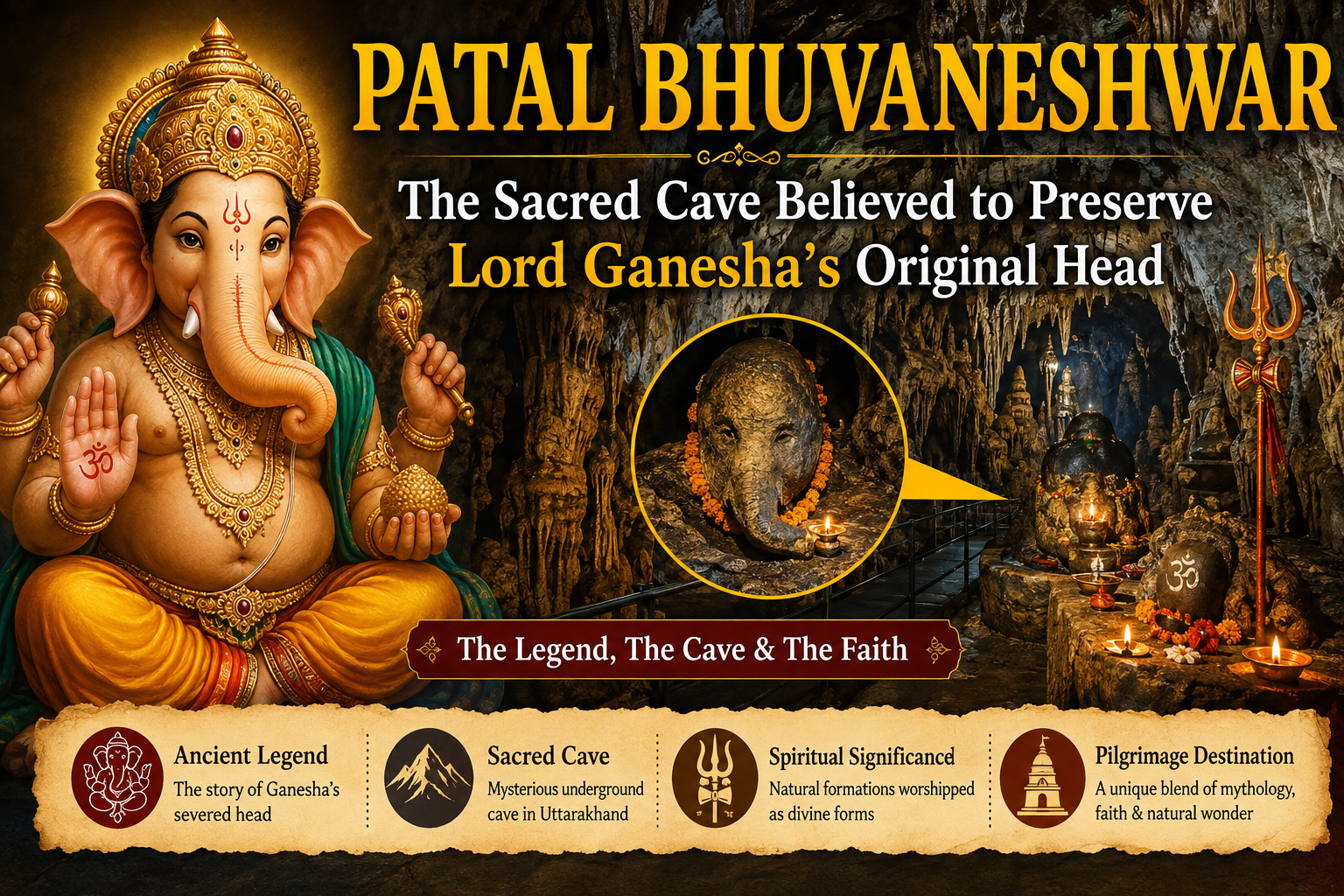
Patal Bhuvaneshwar: The Cave Where Lord Ganesha’s Original Head Is Said to Rest
Inside the limestone chambers of the Kumaon hills, an ancient tradition tells of a stone that remembers what happened the day Ganesha was reborn.
High in the hills of Uttarakhand, past a narrow stone passage that drops you into total darkness, lies a cave that devotees have visited for generations. Its name is Patal Bhuvaneshwar, and among the many things it is said to hold, one belief stands apart: that somewhere within its chambers rests the original head of Lord Ganesha.
It’s the kind of story that stays with you. Not because it asks to be proven, but because it invites you to imagine — to walk through a passage in the earth and stand, even for a moment, at the place where an old and beloved story is said to have left its mark on stone.
The Story Everyone Knows, Told Again
Most of us grew up hearing some version of it. Parvati, wanting privacy while she bathed, shaped a boy out of turmeric paste and breathed life into him. She placed him at the door and told him to let no one in.
Shiva returned home and found a stranger blocking his own entrance. He didn’t know this was his wife’s son — how could he? Words were exchanged, the boy held his ground because his mother had told him to, and what followed was a confrontation that ended in tragedy. Ganesha lost his head.
When Parvati emerged and understood what had happened, her grief was immense enough to shake Shiva himself. He agreed to make it right. His attendants were sent out with one instruction — bring back the head of the first living creature found facing north. They returned with an elephant. Shiva placed it gently on the boy’s body, and Ganesha opened his eyes again, elephant-headed, and beloved ever since.
“The cave does not ask you to believe. It only asks you to stand still and listen.”
So Where Did the Original Head Go?
This is the question Patal Bhuvaneshwar’s local tradition tries to answer. According to devotees who have kept this belief alive over generations, Ganesha’s original head did not simply disappear from the story — it came to rest inside this cave near Gangolihat, in the Pithoragarh district. Deep within its chambers, a naturally formed stone shape is pointed to as that very head, kept safe within the earth ever since.
It’s worth being honest about what kind of story this is. This isn’t a claim you’ll find written the same way across every scripture, nor is it something meant to be tested like a historical record. It is a local, living tradition — the kind that has grown up around the cave itself, passed from pilgrim to pilgrim, generation to generation. And that doesn’t make it any less meaningful. If anything, it’s a reminder that faith often lives not in what can be proven, but in what a community chooses to hold sacred together.
Descending Into Patal Bhuvaneshwar
The cave itself is worth knowing on its own terms, apart from the legend. It sits about 14 kilometres from Gangolihat, formed entirely of limestone, shaped over unknown centuries by water finding its way through rock. Inside, the darkness opens into a landscape of stalactites and stalagmites — some hanging like frozen rain, others rising like small shrines from the cave floor.
Local tradition holds that the cave has been known since ancient times, associated with King Rituparna, and later brought into wider religious memory by Adi Shankaracharya himself. Whether every detail of that history can be independently confirmed is less important, perhaps, than what it tells us — that people have been coming here, and telling these stories, for a very, very long time.
What Pilgrims Encounter Inside
- A rock formation devotees identify as Lord Ganesha’s original head
- Formations associated with Lord Shiva and his presence in the cave
- A shape said to represent Sheshnag, the great serpent of cosmic legend
- Rock structures believed to resemble Shiva’s matted locks, or jatas
- Numerous other natural forms that generations of visitors have connected to Hindu deities
Walking through it, even a first-time visitor can sense why this place became sacred. There’s something about narrow stone passages and sudden underground chambers that quiets the mind on its own — long before anyone tells you which shape is meant to be which deity.
Holding the Legend and the Land Together
There’s a temptation, when writing about places like this, to either declare the legend literal fact or dismiss it entirely. Neither feels honest. The story of Ganesha’s severed head and elephant rebirth is one of the most cherished and widely told episodes in Hindu tradition, even as different regions and scriptures shape its details a little differently. The specific belief that his original head rests at Patal Bhuvaneshwar belongs to this cave alone — a local thread woven into the larger tapestry.
And that’s really the heart of it. Patal Bhuvaneshwar doesn’t need historical proof to matter. Its importance comes from something else entirely — from the pilgrims who have descended into its darkness for generations, from the quiet reverence people bring with them, and from a landscape that seems, almost on its own, to invite devotion.
If You Ever Make the Journey
Patal Bhuvaneshwar sits in the Kumaon region, in a part of Uttarakhand where the mountains themselves feel old. Beyond the cave, the surrounding hills of Pithoragarh offer their own quiet reward — forests, ridgelines, and the particular stillness of the Himalayan foothills that stays with you long after you’ve climbed back up into daylight.
Whether you come as a devotee seeking Ganesha’s blessing, a traveller curious about an unusual underground world, or simply someone drawn to old stories and older stone, Patal Bhuvaneshwar offers something rare: a place where faith, geology, and memory have settled quietly together, waiting for whoever climbs down to meet them.
Frequently Asked Questions
Where is Patal Bhuvaneshwar cave located?
Patal Bhuvaneshwar is located near Gangolihat in the Pithoragarh district of Uttarakhand, in the Kumaon region of the Himalayas, about 14 kilometres from Gangolihat town.
Why is Patal Bhuvaneshwar associated with Lord Ganesha?
Local tradition holds that a naturally formed stone inside the cave represents Ganesha’s original head, from the story of Shiva restoring him to life with an elephant’s head. It’s a sacred local belief rather than a claim from mainstream scripture.
Who discovered or popularised the cave?
Tradition connects its early history to King Rituparna, and says the cave was later brought to wider religious attention by Adi Shankaracharya.
Is Patal Bhuvaneshwar difficult to visit?
The cave is entered through a narrow underground passage, and the pathways inside can be uneven. Visitors should move carefully and follow local guidance while exploring.