Guru Purnima Story: How Lord Ganesha Became Sage Vyasa’s Scribe
Guru Purnima Story: How Lord Ganesha Became Sage Vyasa's Scribe
Every Guru Purnima, devotees remember Sage Ved Vyasa — the compiler of the Vedas and author of the Mahabharata. But few festivals carry a story as rich as the one that connects this day to Lord Ganesha himself.
Why Guru Purnima Honours Vyasa
Guru Purnima falls on the full moon of the Ashadha month and is also called Vyasa Purnima, marking the birth of Sage Krishna Dwaipayana — better known as Ved Vyasa. Vyasa is credited with dividing the Vedas into four parts and compiling the Mahabharata, the Puranas, and the Upanishads. Because he is considered the adi-guru of Hindu scriptural knowledge, students and seekers across traditions honour their own teachers on this day in his name.
The Story: Vyasa Needed a Scribe
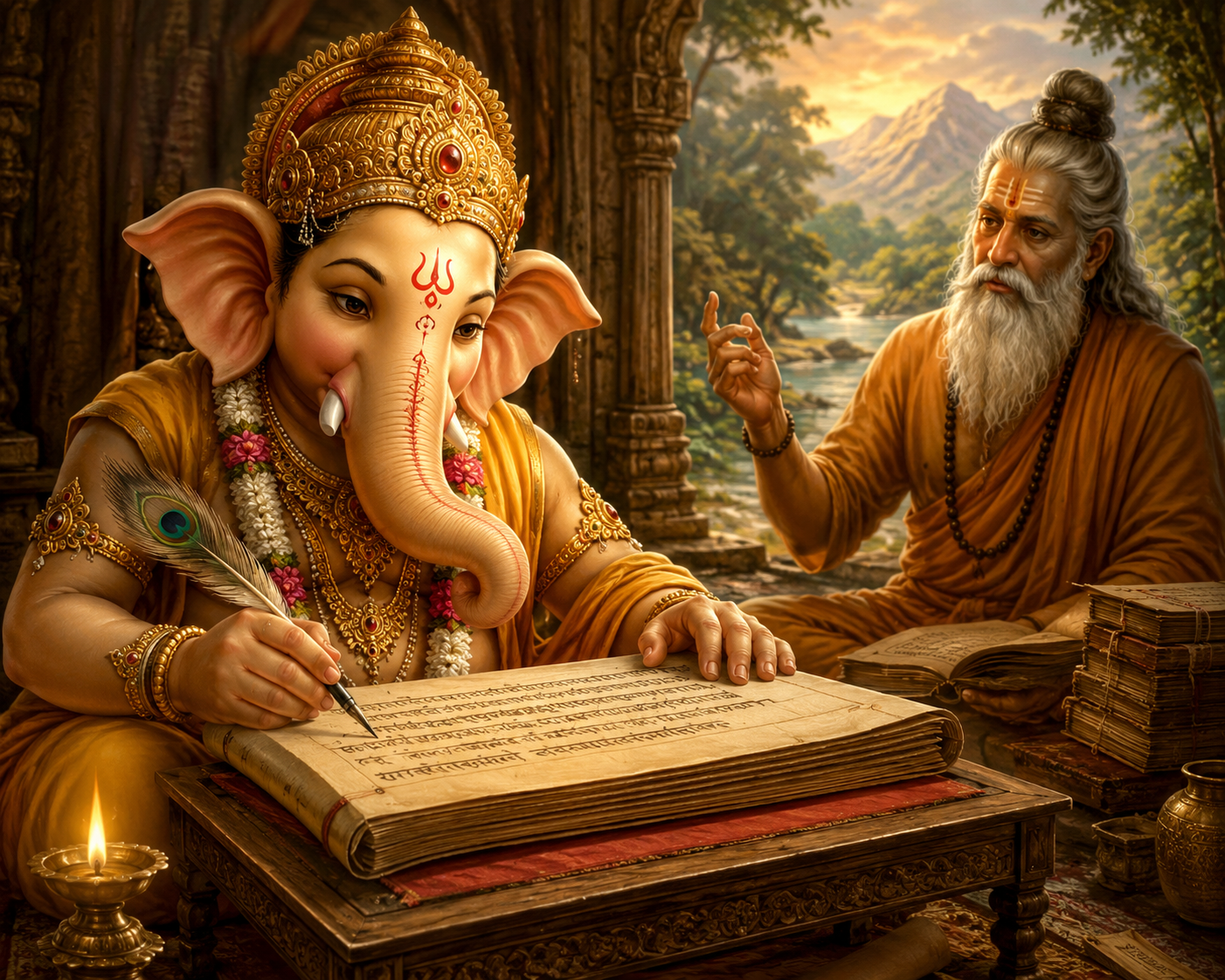
When Vyasa set out to compose the Mahabharata, the challenge wasn't the story — it was speed. The epic was forming in his mind faster than any hand could write. On the advice of Lord Brahma, Vyasa approached Lord Ganesha, the god of wisdom and remover of obstacles, and asked him to be his scribe.
Ganesha agreed — but set a condition: Vyasa would have to recite the entire epic without ever pausing. If Vyasa's voice stopped, so would Ganesha's pen.
Vyasa, in turn, placed a condition of his own: Ganesha must fully understand every verse before writing it down. This single line gave Vyasa exactly what he needed — brief moments to compose the most complex verses in his mind while Ganesha paused to absorb their meaning, all without technically breaking his promise.
The Broken Tusk
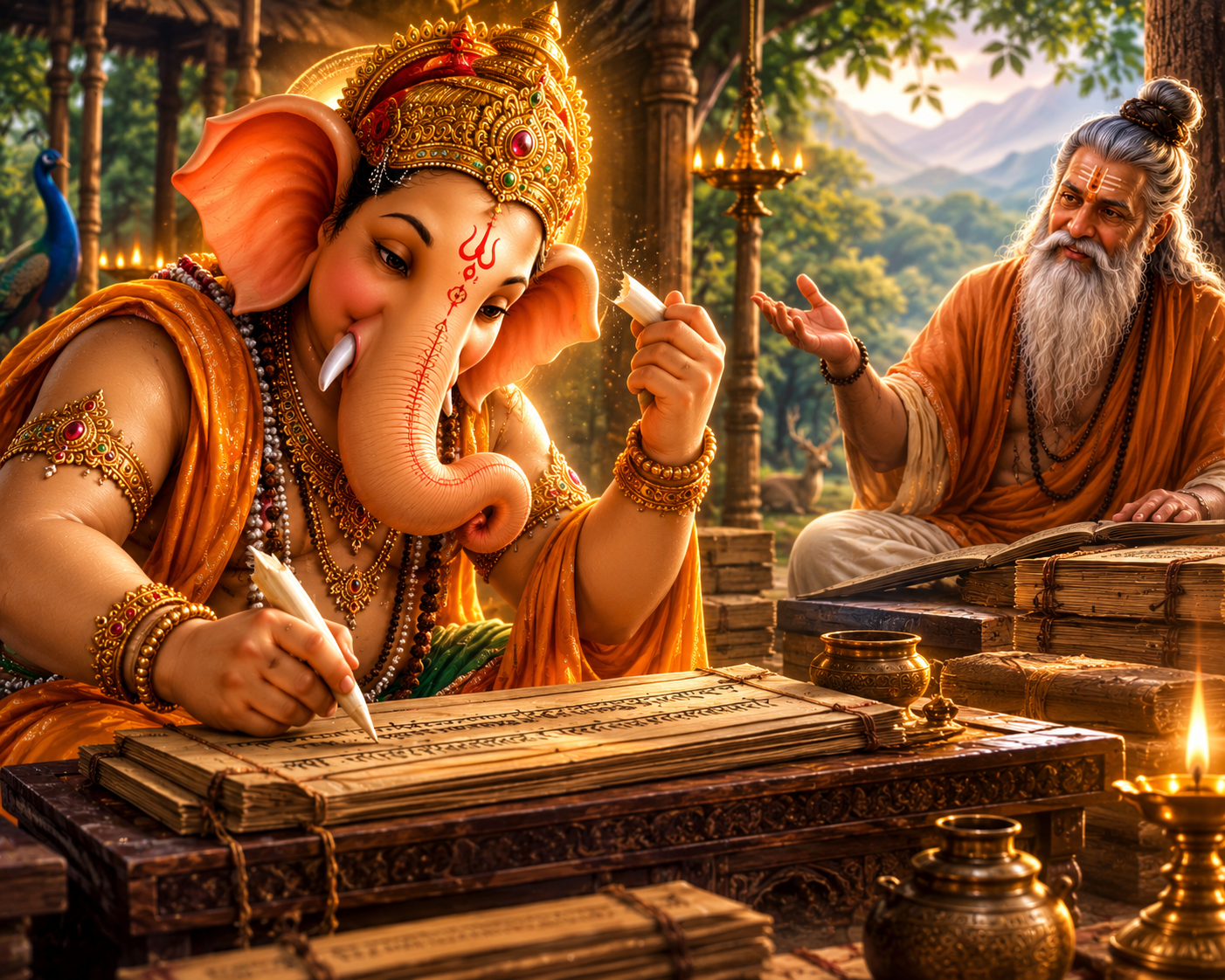
Partway through this marathon recitation, Ganesha's writing implement gave way. Rather than stop — which would have broken his own condition — Ganesha snapped off one of his own tusks and continued writing with it. This is the traditional explanation for why Ganesha is so often depicted with a single, broken tusk.
Together, over what tradition says was three years of continuous recitation and writing, Vyasa and Ganesha completed the Mahabharata, along with the eighteen Puranas and the Upanishads — texts that still shape Hindu thought today.
Near Badrinath, in Mana village, a cave known as Vyas Gufa is still pointed to as the place where this dictation is believed to have happened. Pilgrims visit it every Guru Purnima.
What This Story Teaches
- A student's understanding matters as much as a teacher's speed. Ganesha didn't just transcribe — he insisted on comprehension. Real learning was never about writing fast; it was about understanding fully.
- Discipline is a two-way commitment. Vyasa's unbroken recitation and Ganesha's unbroken writing were both acts of discipline — a reminder that a Guru-disciple bond asks for effort on both sides.
- Obstacles are handled, not avoided. When the tool broke, Ganesha — fittingly, the remover of obstacles — didn't stop the work. He adapted and kept going, using part of himself to finish what he'd started.
- Great knowledge is a partnership. Even the Mahabharata, one of the greatest epics ever composed, needed both a source of wisdom and a means to preserve it. Neither could have done it alone.
Why Ganesha Is Worshipped on Guru Purnima
Because of this story, Ganesha is honoured alongside Vyasa on Guru Purnima — not only as a deity invoked at the start of any undertaking, but as the very first scribe of sacred knowledge. For devotees of Ganesha, this makes Guru Purnima a day to reflect on both the guru who gives wisdom and the discipline it takes to receive and preserve it.